

Supply Chains, Meet Climate Change
(8-minute read)
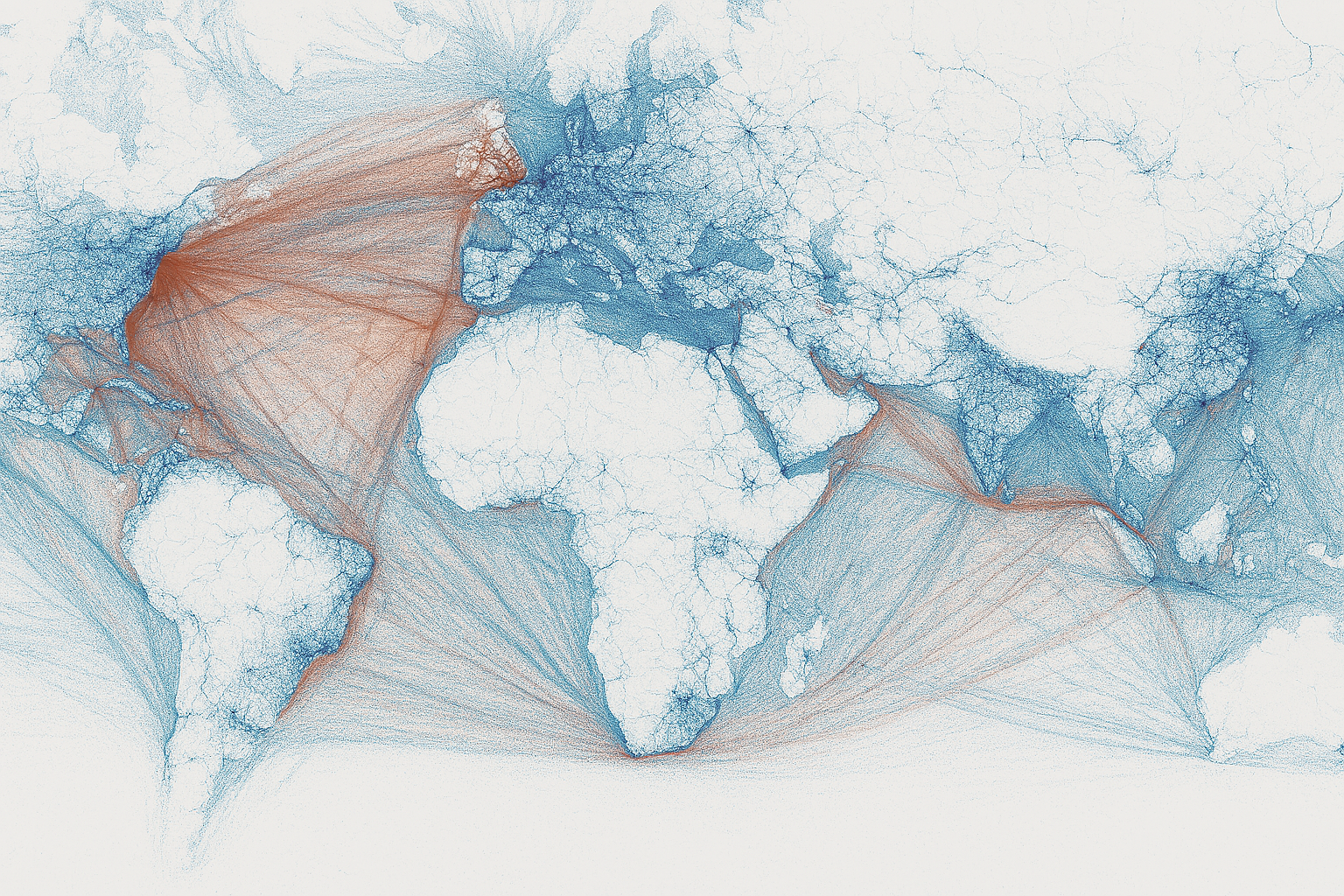
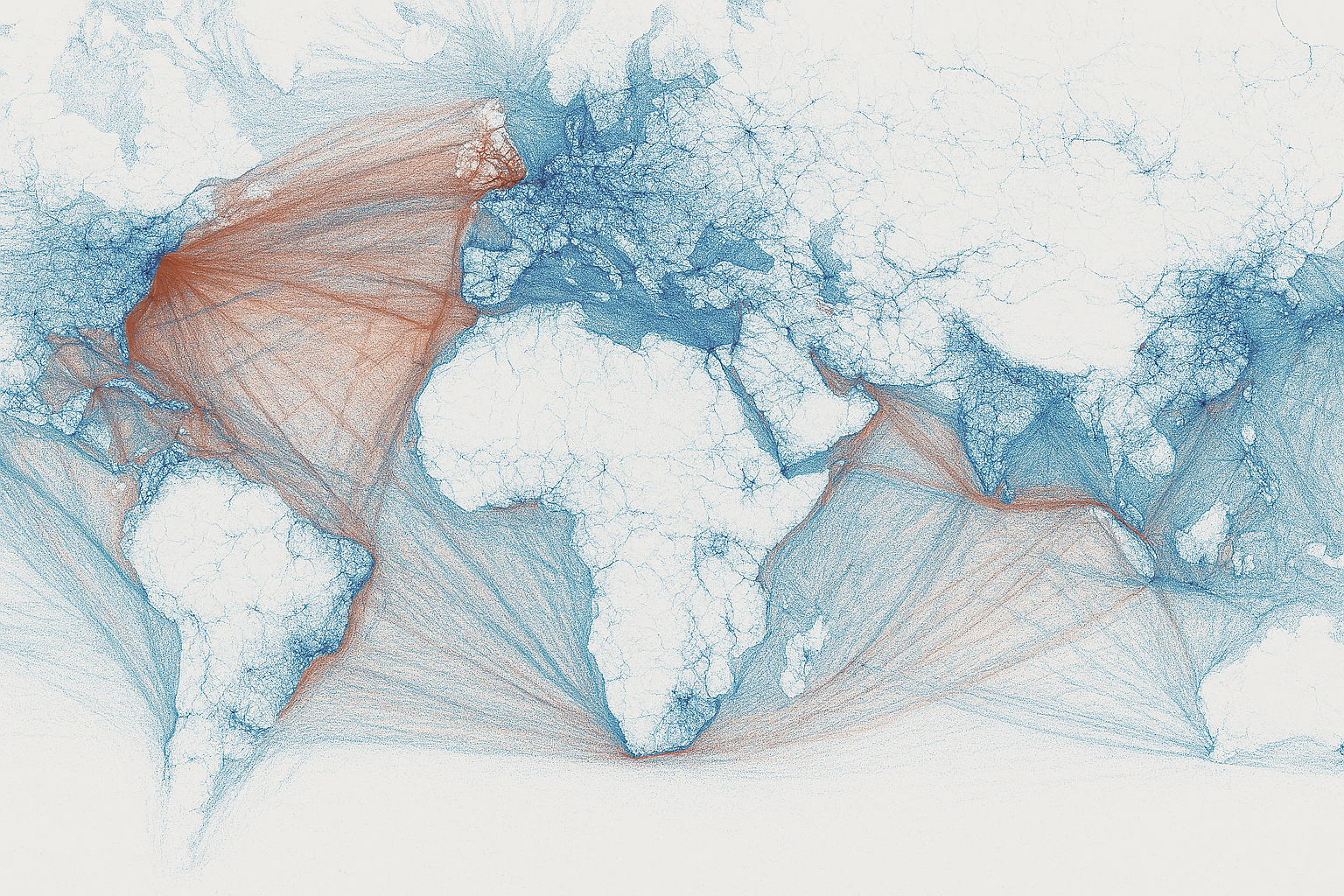
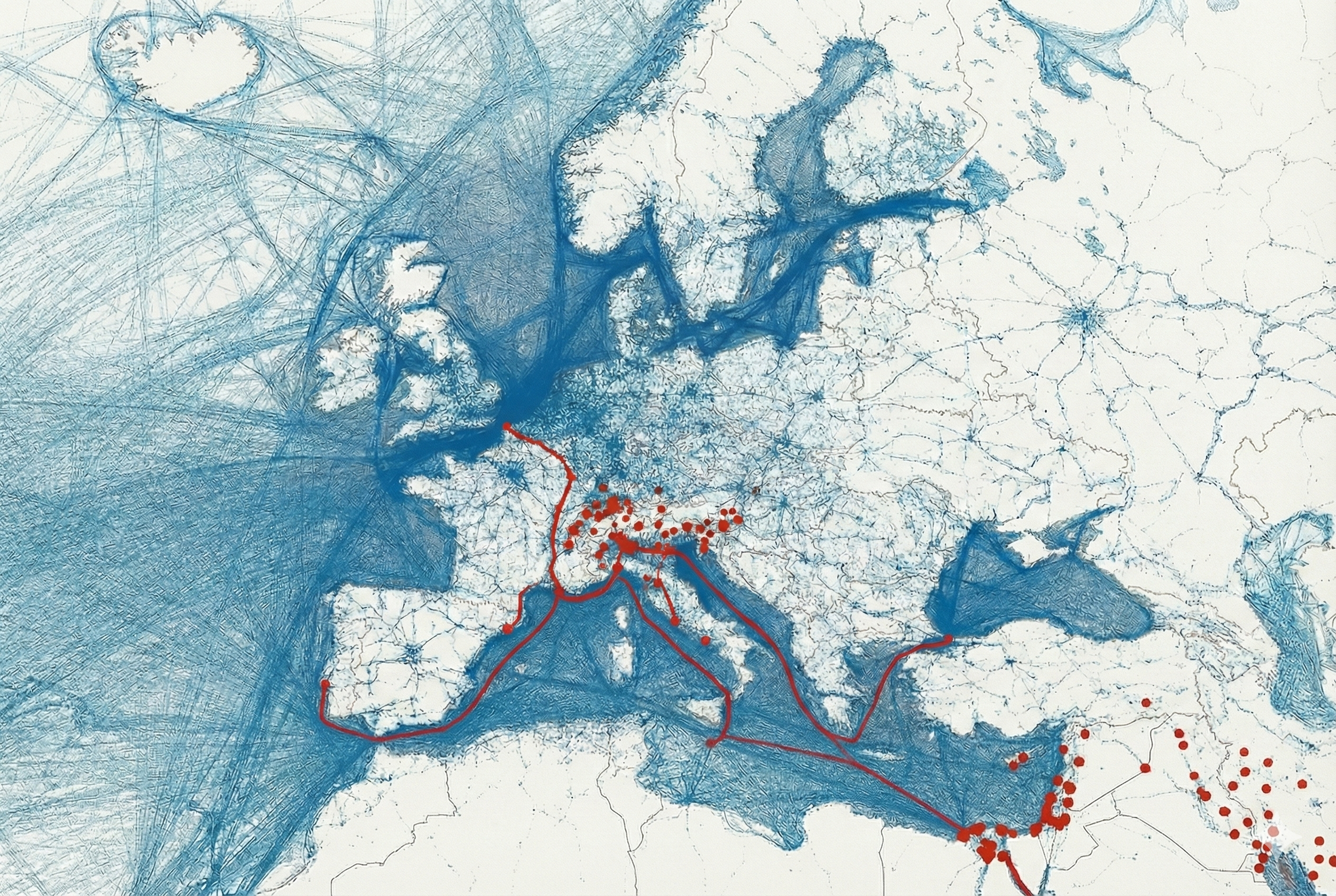
Major maritime (red) and inland trade routes (blue). AI-generated, built on IMF data and subject to inaccuracies.
Supply chains are the arteries of the global economy, continuously pumping goods through thousands of hubs worldwide. Disruption is inevitable, especially as complexity grows, but the cholesterol is rising: climate change, conflict, pandemics, and trade wars all increase the risk of congestion and failure.
Climate change is perhaps the most insidious of these forces. The pipeline of warming is locked in for decades, assuring more volatile and extreme weather regardless of any near-term policy miracles or volcanic eruptions.
Incidents of climate-related supply chain failures are widely documented:
Thai floods shut down auto production in 2011,
Storm Uri in 2021 crippled Texan petrochemical operations, contributing to a global plastics shortage,
Multi-year droughts reduced water levels on the Rhine and Mississippi, constraining bulk commodity flows, and
Drought-driven traffic limits at the Panama Canal slowed global trade in 2023–24.
Layer these climate shocks atop disruptions from trade wars, actual wars, cyberattacks, pandemics, container shortages, and costly supply chain interruptions are imminent.
Disruptions Are Eating Profits
Corporate bottom-lines are taking a major hit. A 2022 survey of 200 manufacturing executives reported losses of up to 13% in a single year, driven primarily by shipping delays. McKinsey estimates that large companies can expect to eat one-fifth of their profits due to supply chain disruptions, and the frequency of these events continues to rise.
Climate risk is a major driver. A recent study by Resilinc.ai recorded a 38% year-over-year jump in supply chain alerts, including a 214% increase in flood alerts, an 88% rise in wildfire alerts, and a 101% increase in cyclone alerts.
Man-Made Vulnerabilities
Decades spent optimizing for lean, just-in-time operations have produced brittle networks overly reliant on suppliers located in climate-vulnerable regions.
Take for example river deltas. These low-lying coastal regions are home the majority of the world’s manufacturing, accounting for more than 6% of the world's GDP, serving as gateways for critical goods entering and leaving hungry economies (Haq and Milliman, 2023).Yet these deltas like the Mississippi, Yangtze, Niger, Bengal, Nile, Indus are shrinking due to subsidence, reduced sediment flows, and sea-level rise - not to mention the cyclone risk.
The Opportunity
Risk and opportunity coexist. Overly concentrated suppliers and high-exposure nodes represent an opportunity to invest. Strengthening these nodes with direct investment or redundancies would shore up much needed finance for local infrastructure and communities that provide the goods, services and labor for a corporate supply chain, all while bolstering local resilience and safeguarding corporate supply chains.
Supply chain analytics, now a $6-9B today could exceed $21-22B by 2030. A more recent and much broader McKenzie study sizes the market at $145–165B by 2030. The key question is, what’s going to drive this growth?
Compliance is No longer Optional
Governments are forcing transparency.
In the U.S., reshoring policies targeting semiconductors, steel, and other strategic goods now require companies to demonstrate full traceability. California (SB 261), Australia (AASB S2), and possibly soon, New York and Illinois, mandate climate-risk reporting across the supply chain.
EU’s Deforestation Regulation (EUDR) requires companies selling goods linked to deforestation—coffee, cocoa, palm oil, rubber, beef, soy, timber—to monitor environmental impacts deep into their supply base. Additional frameworks, including the Uyghur Forced Labor Prevention Act, the UK Modern Slavery Act, and the EU’s anti-greenwashing directive, further extend reporting obligations.
The depth of required visibility still remains low.
In 2015, only 14% of manufacturers could see beyond Tier-1 (Global Manufacturing Outlook, 2015)
By 2025, fewer than half can (Global Manufacturing Outlook, 2025)
And visibility is murky after Tier-2.
This gap is closing. Under California’s SB 261, 4,159 companies (full list) exceeding $500M in revenue must disclose supply-chain climate risks in 2026, many for the first time. Thought the 9th Circuit Court is due to vote on the voluntary vs. mandatory status in coming days, most companies are expected to fully comply out of an abundance of caution.
Demand for tools, data, and service providers is set to surge.
A Working Mini-Thesis
A decade ago, I proposed a simple framework for identifying blind spots in global supply chains: (1) illuminate the supply chain, (2) map its network relationships, and (3) quantify its climate risks.
The approach was the foundation for our supply chain risk measures at Four Twenty Seven, and later our patron, Moody’s, where many enhancements were made, but the methodological steps remain relevant today. Back in 2016, we valiantly attempted to do all three, but as is so often the case in modeling, some specialization is initially required.
Today, emerging providers cluster loosely into three categories:
The Radiologists – illuminate supply chains through tier-mapping.
The Cardiologists – simulate “what-if” scenarios and network effects.
The Surgeons – quantify failure probabilities and prescribe interventions.
The Radiologists
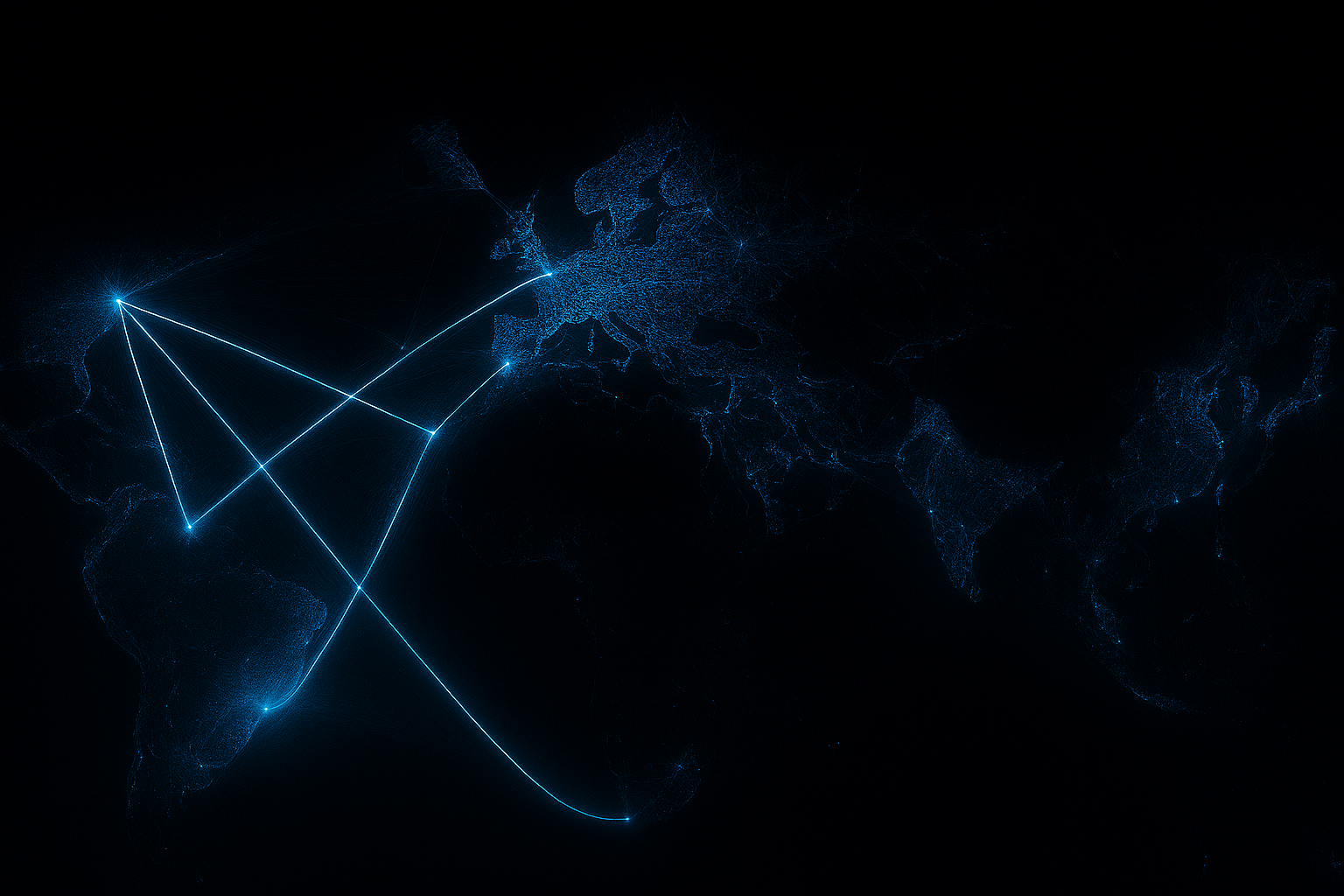
Hypothetical corporate supply chain (bright blue). AI-generated, built on IMF data and subject to inaccuracies.
Full visibility is rare. Traditional survey-based tier-mapping is slow and incomplete, often missing indirect suppliers or raw-material origins. Corporates send surveys to Tier-1 suppliers, which were aimed at gaining information about additional (direct and indirect) suppliers (i.e., Tier-2) until the network map connected retailers to upstream suppliers. This method often fails to capture many indirect suppliers and may or may not pinpoint those extracting, processing, and shipping out the raw materials, which is perhaps the point in the supply chains that carries the most challenges: human right abuses, poor working conditions, environmental challenges, resource shortages, and so on. This is often referred to as “the Tier-N issue.”
The radiologists are the great enablers, with many of the new players focusing on the hardest segment: the first mile of extraction and production. For an even deeper dive into the first mile, I’d highly recommend Ed Conway’s book, Material World. Conway takes on the daunting task of tracing semiconductors and concrete to their origins, which is not practical for many of us.
Epoch
That is why companies like Epoch are so useful. Working with Supply and Vendor Risk Management platforms (SCRM) like Assent, Altana, SupplyShift (now Sphera), to generate a "supply shed" — production facilities and growers that fall within a likely sourcing region based on a probabilistic model that considers things like road connectivity, topology, and land cover.
Take for example one the largest coffee chain in the world sourcing from 2,400 palm oil mills. Pinpointing the location and activities of all these mills through “traditional questionnaires of thousands of multi-tiered suppliers is simply ineffective”, says Epoch’s CEO, Jinal Surti. Once plots are individually identified, Epoch runs their in-house models to assess risks, such as non-compliance with EUDR regulations by looking for the intersection of persistent forest cover, deforestation, and the presence of the target commodity - cocoa, timber, palm, etc. These insights enable companies to quickly and efficiently validate suppliers, disclose risks, while also triaging their ground operations, either by fixing issues or removing problematic sourcing from their processes.
LGND
Enabling much of these geospatial insights is LGND, a relatively new start-up that is building arguably the fastest and most deployable GIS tool to hit the market in years. Both Epoch and N4EA (more below), leverage LGND’s capabilities to quickly train images and identify facilities, crops, or other objects in the logistics chain. LGND’s GTM lead (and former product lead of Kettle), Noam Rosenthal, told me the real added value to companies and analysts is “the ability to geolocate anything in the world very quickly, and integrate it into their workflow”. While the tech may not be optimizing for maximum precision — much like LLMs — it enables those that know what to look for, a quick way to identify and contextualize any object in the world from just a few training images. These satellite-based remote sensing applications may not entirely replace the traditional tier mapping approaches but they’re helping illuminate the blind spots at an unprecedented scale.
The Cardiologists
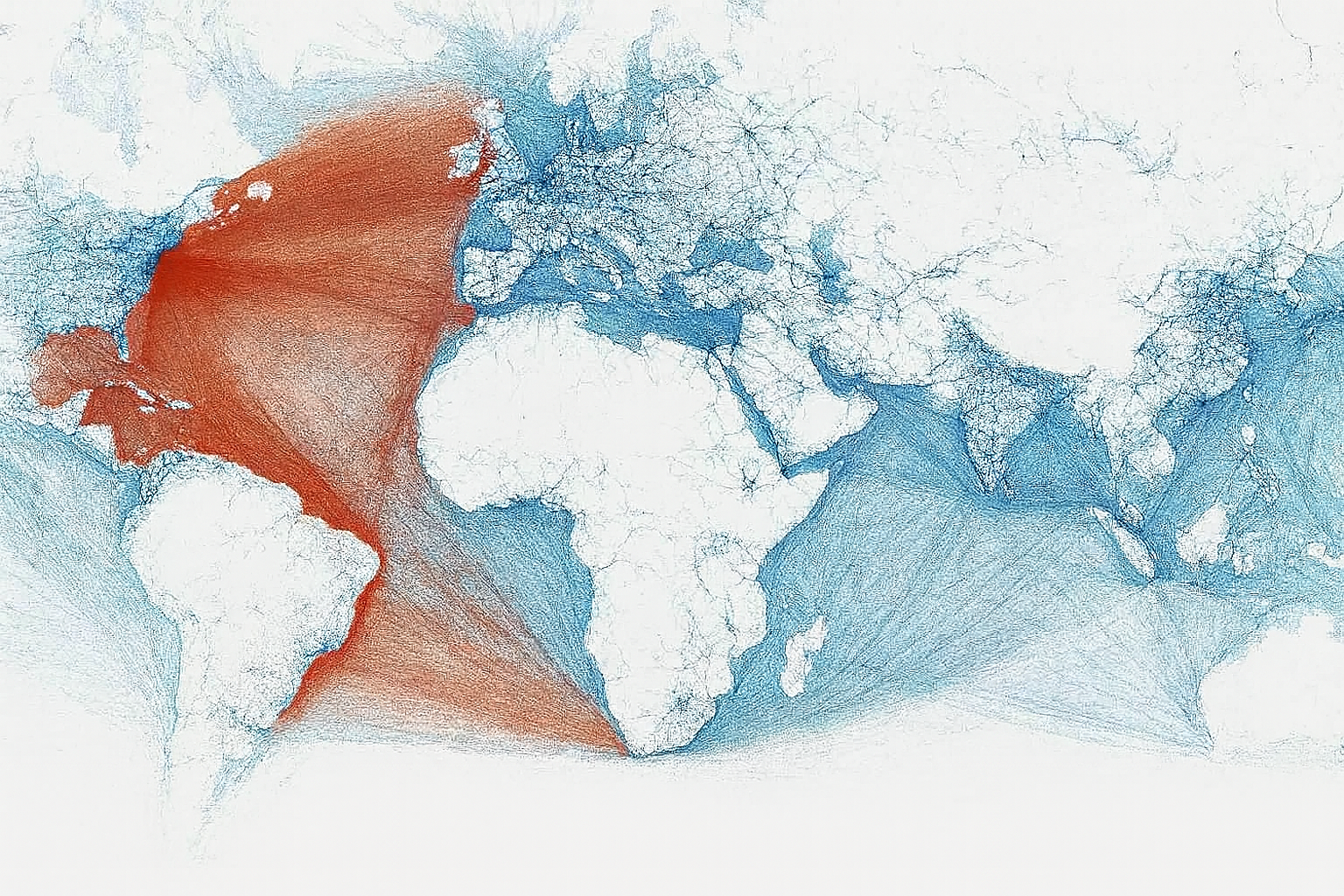
Simulated effect on eastward congestion from disruption of Panama Canal. AI-generated, built on IMF data and subject to inaccuracies.
And next, we have the cardiologists. They’re looking at the entire system, modeling how shocks propagate. A Red Sea disruption, for example, can alter lead times at the Port of Long Beach.
They can quantify “network effects”, illustrating how a single disruption propagates through a network into second and third-order risk cascades. The nature of this work - systems-level what-if scenarios - requires synthetic modeling, which is a fancy way of describing simulations built on troves of data to represent plausible scenarios.
A resilient supply chain behaves more like a neural network: constantly recalibrating across a web of nodes to find the most efficient path, rerouting signals around damages, and optimizing the path of movement. Supply chains must adapt in a similar way, preemptively adjusting sourcing location and routes before and after shocks.
Network analysis enables this. A flooded semiconductor plant in Taiwan is not merely a site-level incident but a shock that can propagate through electronics, automotive, and defense sectors. Modeling these ripple effects is now vital to everything from national security to food security.
N4EA
To my knowledge, N4EA is the only company truly network mapping. “There is a really crucial distinction here around what people mean when they talk about "network mapping" - for us, that's the literal geographic infrastructure. For others, this can be relationships between specific suppliers”, says N4EA’s CEO, Sadie Frank.
Many of their peers either provide static risk alerts (“rain is coming” or “port strike in Long Beach”) or take an agent or asset-based approach (“here is your factory”). In contrast, they map those factories into our proprietary geospatial network and then run impact modeling to show how specific networks react to disruptions, with quantified and ranked alternative options.
Founded in 2024 by the brother and sister duo, Sadie and Harrison Frank, this pre-seed company got off the ground thanks to resist.vc and is now fundraising (~$2M target). The name is an amalgamation of ‘Networks’ + ‘Fourier’. Networks because they leverage networks/complexity science, and Fourier because Joseph Fourier was a mathematician dedicated to using math to solve real world problems. The name also embodies their ambition - work within the principles of chaos theory and make sense of the complexity.
The Surgeons
Highlighted areas of risk are for illustrative purposes only. Image is AI-generated, built on IMF data and subject to inaccuracies.
And finally, we arrive at the surgeons. If the radiologists illuminate supply chains and the cardiologists simulate network effects, the surgeons are the ones who narrow in on and reduce risk. They layer site-based, probabilistic estimates of failure over the lattice of the supply chain, assigning a likelihood of failure at specific nodes, and prescribe actionable risk reduction measures. Results help triage the most vulnerable assets or suppliers and guide companies toward decisions that can meaningfully reduce downtime, losses, or even regulatory exposure. These companies sit at the intersection of applied climate science and operational resilience.
Correntics
Switzerland-based Correntics is a quintessential example of this emerging class of young companies reducing physical climate risks across a supply chain. Founded in 2021 and backed by early investors including S2S Ventures, Serpentine, Sictic, Respire, and Zürcher Kantonalbank, the company builds climate-intelligence systems for some of the world’s most exposed sectors from agribusiness giants like Syngenta to utilities such as BKW and consultancies like Deloitte. What sets them apart from other climate data vendors (stay tuned for a Vector-led study in early 2026) is their ability to integrate tomorrow’s weather, seasonal climate outlooks, and end-of-century projections into a continuous and fully customizable view of risk.
They don’t do any supply chain mapping themselves. After experimenting with agent-based models, the team — led by CEO Michael Gloor — concluded that no single tool can reliably map complex, multi-tiered supply chains, but when provided with a supply chain map, they apply a blend of climate, geohazard, and operational exposures. With a Seed A round planned for 2026, Correntics is positioning itself to become the go-to provider for heavy industry, surgically identifying failure points, and helping operators build resilience before the next shock hits.
The Takeaway
A decade of shocks — from pandemics to droughts, trade wars, and cyber-attacks — have rippled through our increasingly interconnected trade networks, exposing their complexity and fragility. Disruptions could soon consume up to one-fifth of corporate profits annually, while regulators are starting to mandate unprecedented transparency into the murky tiers of global sourcing.
The convergence of rising climate risk and tightening compliance is moving supply chain initiatives to non-discretionary budget items. Just as ERP systems became the system of record for managing business in the early 2000s, supply chain intelligence providers that illuminate, monitor and model supply networks (and predict their disruptors) will become essential tools for SCRM platforms and corporate teams in the coming years.
This shift creates a window for emerging providers to challenge incumbents, especially if they join forces, sharing data and leveraging technologies to uncover the blind spots, understand the broader network effects, and actually intervene to reduce risks.
—
Vector Deep Dives explore the emerging technologies and approaches addressing some of the toughest adaptation challenges. Sign-up below and get the next deep dive issue delivered to your inbox.